
Fight against free speech: German Court interprets anti-Nazi post as right-wing extremist
Ein Beitrag von
A man criticizes National Socialism – and ends up in court. Not for glorifying it, but for comparing it to the present. A judicial ruling from Baden-Württemberg shows how a statute designed to protect against Nazi propaganda is turning into an instrument by which sharp criticism of the government comes under criminal suspicion. This is precisely the development J.D. Vance warned about a year ago. NIUS has obtained the court decision and analyzes its full social implications.
This is the text prosecutors consider potentially criminal:
“HOW IT STARTED IN 1933
The media was controlled,
parties were banned,
children were indoctrinated,
opinions were suppressed,
the people were divided,
reporting offices were established,
dissenters were betrayed,
citizens were defamed”
Exactly one year ago, the current U.S. Vice President J.D. Vance struck unusually harsh tones toward Germany and the European Union. In a widely noted speech, he warned that freedom of expression in Europe was increasingly coming under state pressure. He emphasized the shared values of America and Europe, rooted in a common historical genesis, and admitted self-critically that the United States, too, had failed to live up to them in the recent past – during the COVID period.

J.D. Vance said what German elites don't want to hear.
Vance: “We must do more than just talk about democratic values; we must live them”
He said: “For years we’ve been told that everything we fund and support – from our Ukraine policy to digital censorship – is done in the name of our shared democratic values. But when we see European courts overturn elections and senior officials threatening to do so again, we should ask whether we ourselves are holding to equally high standards. And I say ‘ourselves’ because I firmly believe we are on the same side. We must do more than just talk about democratic values; we must live them.”
What many German media and political elites dismissed at the time as exaggerated American provocation acquires a cutting relevance exactly one year later.
Against the betrayal of dissenters
The case concerns criminal proceedings from Baden-Württemberg. In spring 2024, a man posted a historical black-and-white photo on Facebook showing children with swastika flags. The accompanying text draws a parallel between developments in 1933 and present political conditions.
The criticism that “dissenters are betrayed” and “citizens defamed” in particular points to a bourgeois-intellectual framework of thought. One that, as the subsequent course of proceedings shows, the authorities are unwilling to grant him – citing his AfD party membership.
Prosecutors dig in
The Offenburg public prosecutor’s office classified the post as the use of symbols of unconstitutional organizations under Section 86a of the German Criminal Code and filed charges on May 31, 2024. On January 20, 2025, the Offenburg district court initially refused to open the main proceedings, arguing that the contribution did not meet the statutory elements of the offense.
But the prosecution did not relent. On January 24, 2025, it filed an immediate appeal and continued to push for criminal proceedings. After the district court declined to remedy the complaint on January 28, 2025, the matter went to the Offenburg regional court. On March 24, 2025, that court overturned the district court’s decision. The main trial will now proceed.
NIUS has the regional court’s decision. Because the case is ongoing, no direct quotations may be published. A substantive reconstruction is permitted.
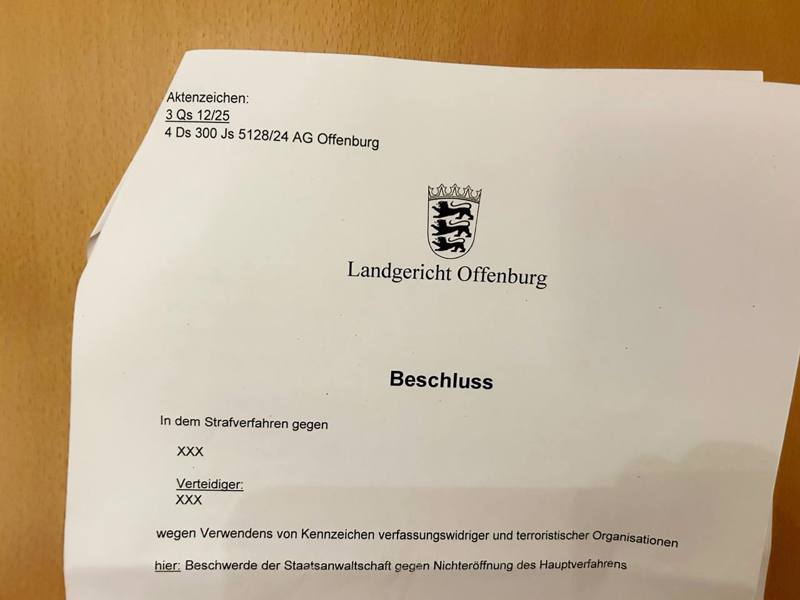
NIUS requested that the non-public decision be sent to them.
The chamber first establishes that the swastikas visible in the image objectively constitute symbols of the NSDAP. The decisive issue is whether an exception applies – that is, whether the post is clearly and unambiguously understandable as criticism of National Socialism. According to established case law, such symbols may be permissible if they are recognizably used to reject the ideology.
The regional court denies precisely this exception. The chamber argues that the post primarily targets present political conditions and merely uses National Socialism as a comparative backdrop. In its view, the symbol is therefore not deployed to criticize the Nazi regime itself but as a polemical device against the present. That, the court holds, is insufficient to satisfy the protective purpose of Section 86a.
An expansive reading of a statute
It is striking how far the court extends its interpretation of the paragraph. The issue is no longer only preventing a revival of National Socialist ideology. The decision explicitly states that even the impression at home and abroad that such symbols are tolerated in Germany must be avoided.
A paragraph historically created to suppress anti-constitutional propaganda thus becomes an instrument of preventive control and repression. No longer is the central concern the defense against genuinely dangerous ideology – the worry that once moved the legislature. Instead, pointed political criticism is coming under general suspicion.
The ruling becomes especially questionable toward its end. There, the court refers to the defendant’s AfD membership and to the fact that parts of the party have been classified by domestic intelligence authorities as “confirmed right-wing extremist” – authorities that operate under government direction.
Formally, the court emphasizes that party affiliation alone must not lead to a direct inference about his convictions. In practice, however, this political classification becomes a benchmark for interpreting the overall case. The question of how a post is to be understood is no longer answered solely from its content, but from the party-political attribution of its author, while the governmental background of that attribution – domestic intelligence does not operate beyond party interests – is simultaneously obscured. It is a striking example of the power mechanics of “our democracy.”

Marion Gentges (CDU), Minister of Justice and Migration in Baden-Württemberg
The government officials ultimately responsible for the prosecutorial appeal belong to Baden-Württemberg’s Green-Black state government; jurisdiction lies with the CDU-led Ministry of Justice under Minister Marion Gentges.
Vance might think: Here we go again
In effect, the standard of judicial evaluation shifts. It is no longer decisive solely whether a symbol glorifies National Socialist ideology. What becomes decisive is whether the political thrust of a contribution appears sufficiently unambiguous. Clear opposition to National Socialism from the perspective of an average observer is no longer enough; it must also target the politically correct addressees.
How the court will ultimately rule remains open. What has been described here is only the reasoning for opening the proceedings.
One thing is already certain, however: one year after Vance’s warning, this decision reads like yet another confirmation of what he addressed to Europe’s elites with unusual clarity – that the values of Western democracy are at stake not only in Sunday speeches, but in the concrete practice of state institutions.
Mehr NIUS:
Bundeshauptstadt des Bürgergelds: Ausgerechnet Bremen schmeißt den kritischen Jobcenter-Mitarbeiter raus
Merz bringt Merkels fatale Migrations-Parole: „Wir schaffen das!“
Verfassungsschutz: Extremisten in Berlin immer jünger, linker und islamistischer
Keir Starmer kniete für George Floyd, schwieg aber monatelang zu Henry Nowak
Merz’ katastrophale Kommunikation – die große Analyse
Wie die EU mit dem „Democracy Shield“ den Generalangriff auf die neuen Medien plant
Nach Champions-League-Finale: Paris siegt, Paris brennt
Liberal & Remmidemmi: Wie die FDP zurückkommen will, in Köpfe und Parlamente
Mehr NIUS:
Keir Starmer kniete für George Floyd, schwieg aber monatelang zu Henry Nowak
Merz’ katastrophale Kommunikation – die große Analyse
Wie die EU mit dem „Democracy Shield“ den Generalangriff auf die neuen Medien plant
Nach Champions-League-Finale: Paris siegt, Paris brennt
Liberal & Remmidemmi: Wie die FDP zurückkommen will, in Köpfe und Parlamente
„Wärmster Sommer seit 2000 Jahren“ – die faulen Tricks hinter den Klima-Superlativen
„Burn the old white men“ soll keine Volksverhetzung sein, weil die Parole sich „nicht gegen einen bestimmten Bevölkerungsteil“ richte
Grüne Klimaideologie: So werden die Menschen in den Entwicklungsländern ärmer
Felix Perrefort
Artikel teilen
Kommentare