
HateAid – NIUS explains how the German Censorship Complex operates
Ein Beitrag von
In February 2025, a CBS “60 Minutes” team travels to Germany to document the state’s battle against free speech. What the American journalists find is a country whose powerful seem to have drawn a fatal lesson from two past dictatorships: that, in the future, the right people must finally be silenced.
Alongside the smugly grinning prosecutors of Lower Saxony’s “Central Office for Combating Hate Crime on the Internet,” who gush to CBS about their home searches while casually declaring the rule of law essentially over (“Confiscating a phone is already a punishment — it’s even worse than a fine”), a quote from Josephine Ballon makes headlines around the world.
The managing director of the organization HateAid claims: “Free speech needs boundaries. And in the case of Germany, these boundaries are part of our constitution. Without boundaries a very small group of people can rely on endless freedom to say anything that they want, while everyone else is scared and intimidated.”
Half a year later, on October 1, 2025, German President Frank-Walter Steinmeier awards Ballon’s ally, HateAid co-founder Anna-Lena von Hodenberg, the Federal Cross of Merit. The Office of the Federal President praises von Hodenberg for “strengthening democratic core values online” and “working at the EU level for a safe and democratic internet.” The Orwellian inversion is complete. The fight against citizens’ freedom “to say whatever they want” — the fight against free speech — is celebrated by the highest state authority as a defense of democracy. Even East Germany called itself “democratic” until the very end.
The Reinterpretation of Free Speech
Anyone who examines HateAid’s work closely sees that the organization enjoys the government’s favor for one reason: it enables the powerful to reframe the fight against critics of the government as an act of democracy. HateAid’s greatest achievement is not winning lawsuits or securing public grants. Its greatest achievement is the reinterpretation of what free speech means. The narrative HateAid has embedded in the mainstream consists of three simple rules:
Censorship is “free speech.”
Free speech without censorship is “hate.”
Ending censorship is an “attack on free speech.”
And because the American government has set out to dismantle the European censorship complex of agencies, tech companies, and government-adjacent organizations — imposing sanctions on both Ballon and von Hodenberg — leftists from Berlin to Brussels to Paris are losing their minds. They claim the end of free speech has arrived precisely at the moment when a global power stands up against Europe’s state censorship.
Yet HateAid repeatedly reveals its own hostility toward free speech. The organization regularly attacks critical reporting. For instance, it attempted to legally prohibit NIUS from publishing the following statement in a June article this year: “HateAid is a nonprofit limited liability company that received around 4.7 million euros in taxpayer money by 2024. Officially, it fights ‘hate online.’ In reality, however, it primarily helps left-wing politicians take action against citizens’ statements and create legal precedents.” HateAid argued that the claim that the organization “primarily helps left-wing politicians take action against citizens’ statements” was false and caused HateAid “serious and lasting harm,” since only a small percentage of those supported by HateAid were politicians.
But the Berlin Regional Court ruled that the statement was a “permissible expression of opinion” — in part because there were “sufficient factual connections” for such an opinion. After all, HateAid openly admits helping officeholders and elected officials. The court also emphasized NIUS’s “public information interest” and its “press and media freedom,” which “would be fundamentally affected” if the court sided with the plaintiff. In other words, HateAid tried to censor legitimate opinions and restrict press freedom.
Close Ties to Left-Wing Parties
Nevertheless — or perhaps because of this — the organization receives millions in taxpayer money: at least around 5.1 million euros since its founding in 2018. The money funds legal counseling and litigation financing. HateAid is also heavily involved in producing studies on alleged “online hate” and in implementing the EU’s Digital Services Act (DSA) in Germany. Since June 2025, HateAid has also been an officially certified Trusted Flagger.
Slowly but persistently, HateAid has succeeded in shaping the discourse on free speech and emboldening left-wing politicians who believe they have the right to crack down on unwelcome opinions.
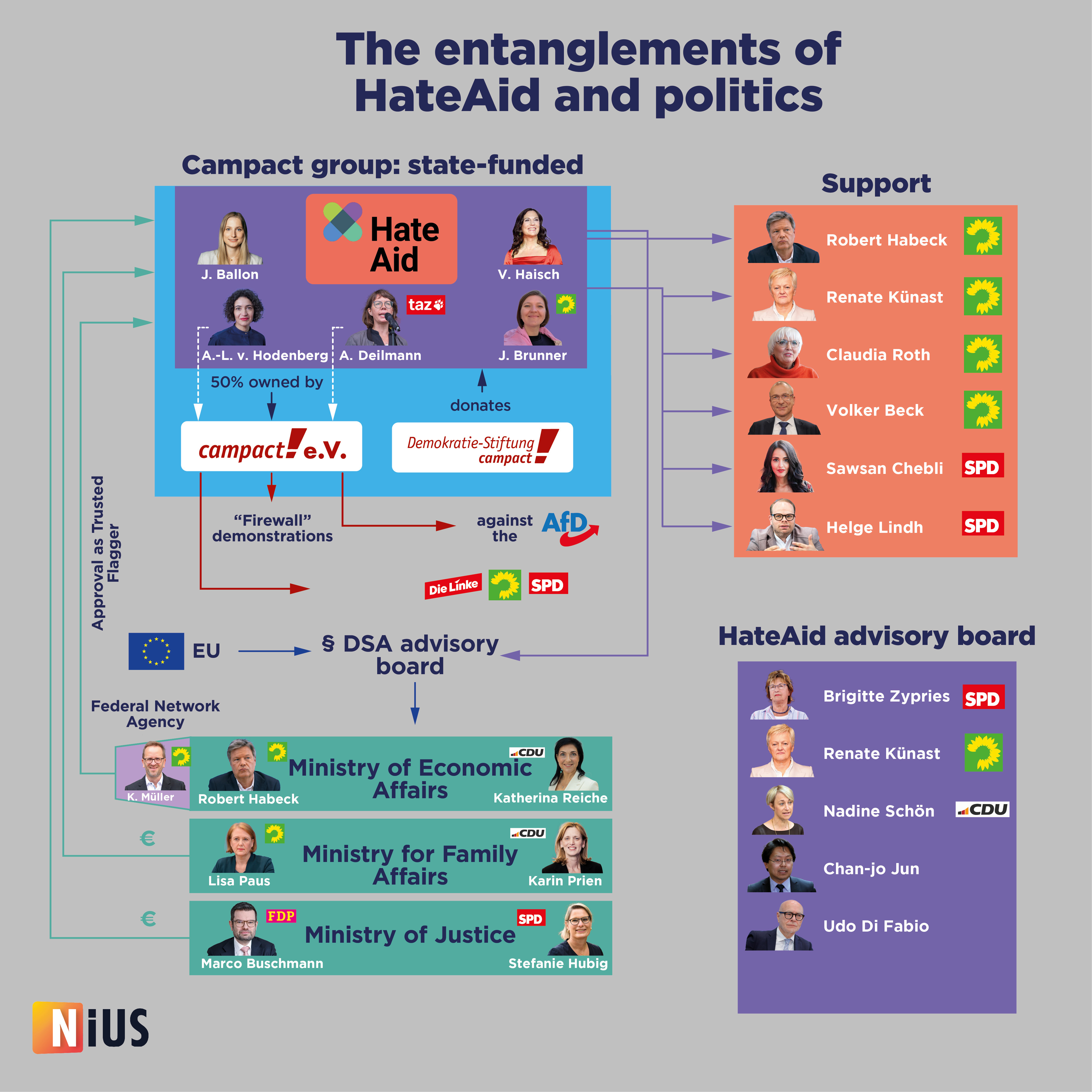
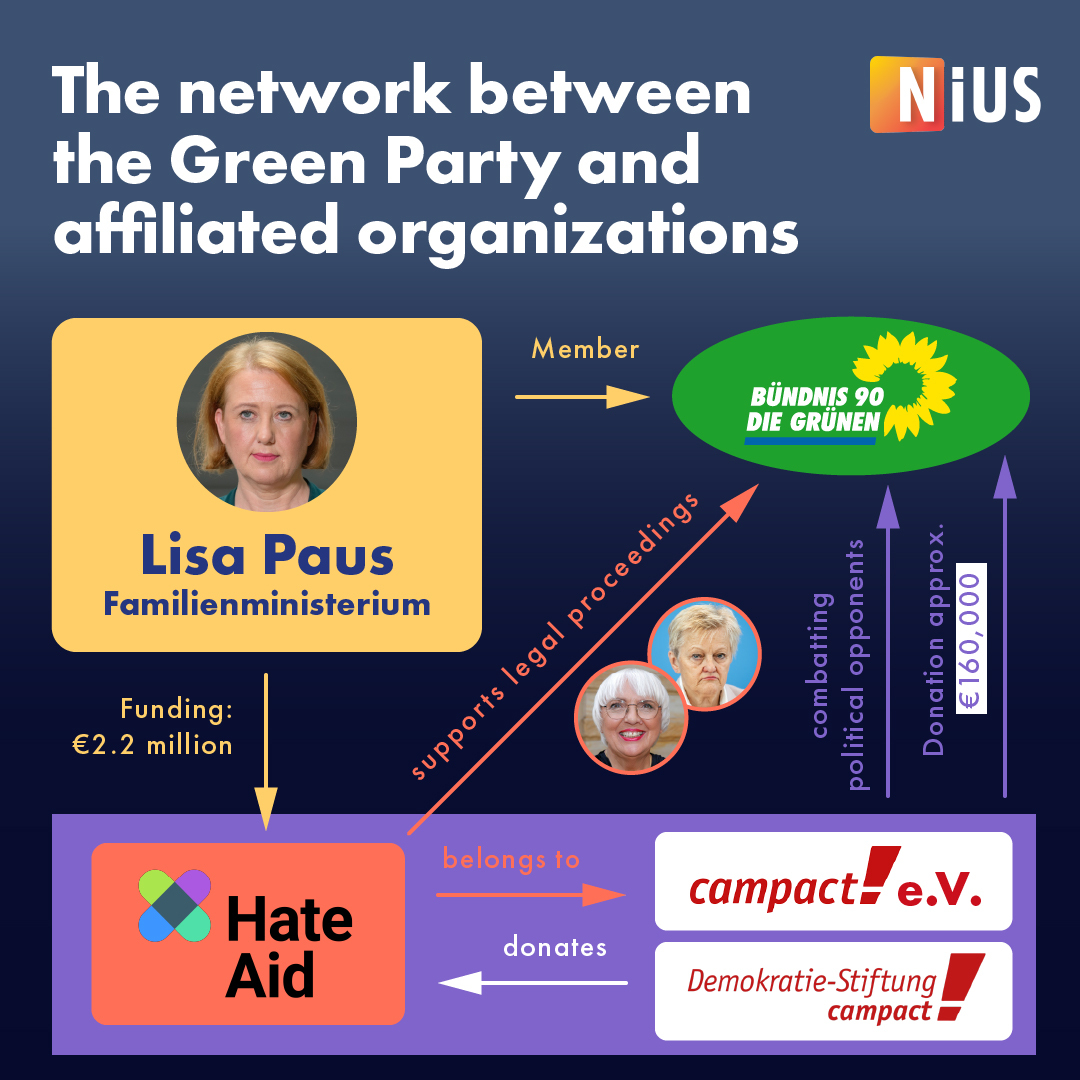
The political bias of the organization is evident in its history. HateAid emerged from the left-wing campaign group “Campact e.V.,” devoted to fighting “the Right.” Half of the share capital came from this association, which still holds around 33 percent of the shares in HateAid today. Anna-Lena von Hodenberg also worked for the group before co-founding HateAid in 2018. Campact agitates with petitions, rallies, and its website against the conservative opposition: ahead of the 2025 federal election, Campact launched a campaign against then-opposition leader Friedrich Merz (CDU). It also demands consideration of a procedure to ban the AfD.
Left-wing parties, meanwhile, can rely on Campact’s support. During several state election campaigns in eastern Germany in 2024, the group donated hundreds of thousands of euros to candidates from the SPD, Greens, and Left Party — and for the upcoming 2026 state elections in Saxony-Anhalt and Mecklenburg–Western Pomerania, it has already raised a million euros for a “No-AfD Fund.” These are private donations, not public funds. But the connection to HateAid raises questions. After all, the organization in which Campact is a shareholder received millions in taxpayer funds under Green leadership. This raises the suspicion that Campact saved its own resources thanks to public subsidies — leaving more money available to support the Greens. Campact and HateAid vehemently deny this.
A Joint Fight Against Citizens’ Speech
These tight links to left-wing parties are why many observers see HateAid as a state-funded left-green front organization. HateAid also maintains close relationships not only with left-wing parties, but with their personnel.
Among HateAid’s clients are numerous left-wing politicians — from Green Party figures Robert Habeck, Volker Beck, Claudia Roth, and Renate Künast, to SPD’s Sawsan Chebli. HateAid leaves the public largely in the dark about the nature of the support it provides. It merely states that it assists these politicians in taking legal action against speech-related offenses. The conflicts of interest are obvious: HateAid repeatedly helped Green politicians fight citizens’ speech, while then–Family Minister Lisa Paus — a Green — was simultaneously responsible for awarding the organization’s funding.
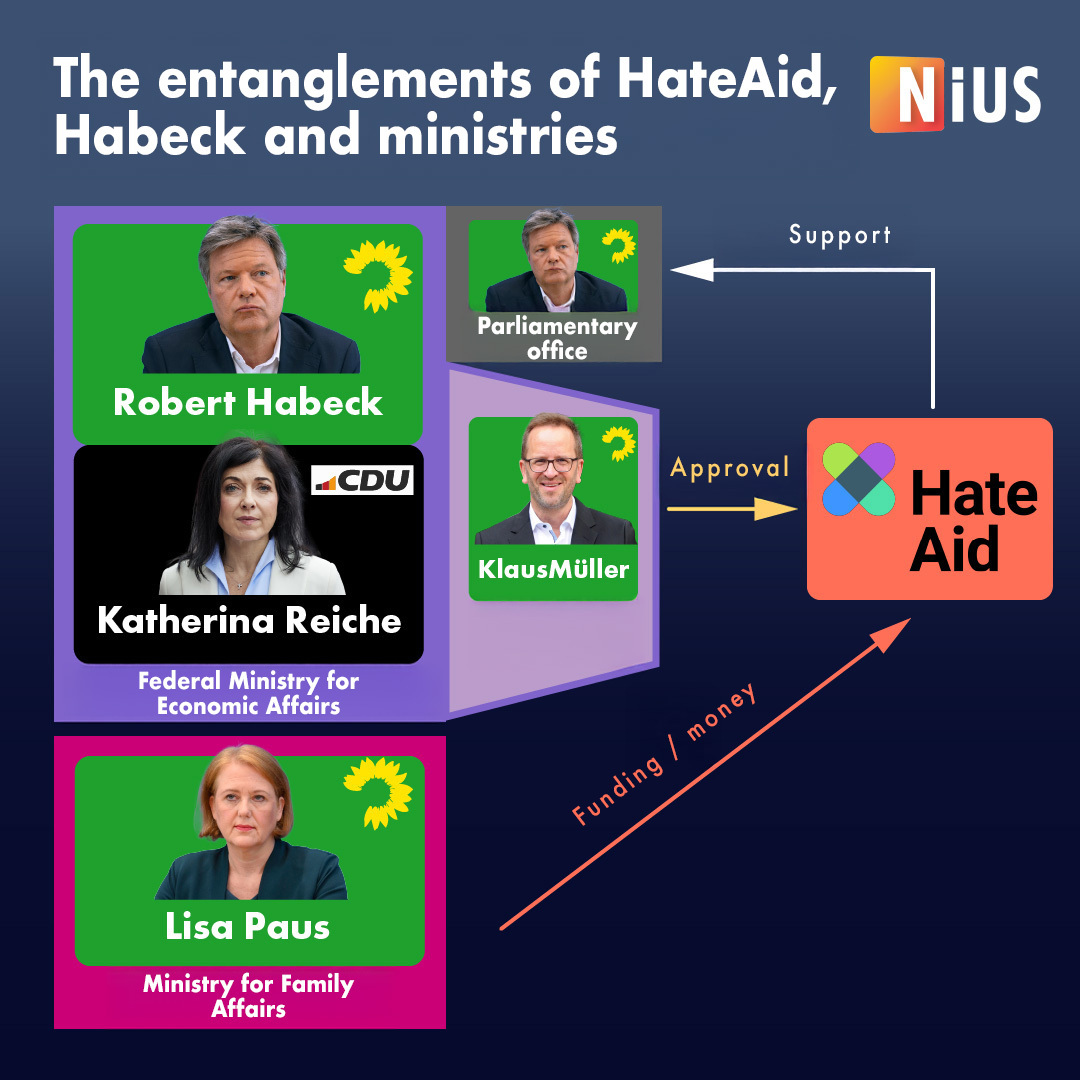
One particularly explosive collaboration took place during this period: HateAid’s unpaid support for then–Economy Minister and Vice Chancellor Robert Habeck (Green). Between April 2023 and July 2024, the minister filed more than 700 criminal complaints — some through his parliamentary office, others through the ministry.
Habeck is among those politicians who routinely take legal action against legitimate expressions of opinion: he signed a criminal complaint against pensioner Stefan Niehoff, who had shared a meme calling Habeck a “moron,” triggering a dawn raid. He filed a complaint against Welt columnist Rainer Meyer (Don Alphonso) because Meyer wrote that Habeck was “an economics minister who wouldn’t stand out negatively among a crowd of train-station alcoholics.” He filed another complaint because he claimed his “honor was violated” by a poop emoji posted under one of his tweets by an angry citizen.
Democracy requires politicians to endure harsh criticism. Yet the government now has at its side an organization that intimidates citizens on its behalf. What the collaboration looked like in detail remains unclear. NIUS asked HateAid which services it provided to Habeck and what their monetary value was. The organization refused to answer. Nor does HateAid say which alleged speech offenses it assisted Habeck with. HateAid is transparent only when it targets clear-cut insults — all other cases remain shrouded in secrecy.
The government of SPD, Greens, and FDP was clearly aware of how explosive the Habeck support was. To cover it up, it lied. In response to a written inquiry by AfD MP Martin Renner, the Justice Ministry claimed: “The federal government has no knowledge that members of the federal government have used services from HateAid gGmbH in that capacity since 2018.” But the collaboration with Habeck was already publicly known. HateAid then tried to challenge parts of the NIUS reporting in court but lost. Both sides appear eager to conceal the organization’s close ties to left-wing politicians whenever things get too uncomfortable.
“Below the Threshold of Criminal Liability”
The alignment between HateAid’s interests and those of left-wing government members became clear again in February 2024 when comments at a press conference by then–Family Minister Paus sent shivers down the spines of her political opponents. The occasion was the presentation of a study titled “Louder Hate – Quieter Withdrawal: How Online Hate Threatens Democratic Discourse.” HateAid was a co-publisher.
Paus told the assembled journalists: “We also want to take into account the fact that hate online can occur below the threshold of criminal liability. Many enemies of democracy know exactly what still falls under free speech on social media.” Her words foreshadow the government’s large-scale assault on free speech in the years to come. Paus sets the tone in a debate where criminal liability — the key limit of the rule of law — is replaced by subjective feelings as the measure of whether speech is legitimate.
The study itself provides ammunition for this. It defines “online hate” entirely by the subjective feelings of those who claim to be affected. Among the statements it considers “hate” are claims that Islam is conquering Europe, that migrants should leave Germany, or that one’s own culture is superior. Legitimate positions — held wholly or partly by millions of conservatives across the country — are thus rebranded as illegitimate hate. With a view to the upcoming state and European elections, the authors express an “expectation” toward policymakers: there is “urgent need for action against online hate.”
Trailblazer of the Digital Services Act
Soon, HateAid would get the chance to turn this supposed “need for action” into reality and help build the German censorship complex. To implement the DSA in Germany, the Federal Network Agency — headed by Green politician and Habeck ally Klaus Müller — appoints an advisory board. According to the agency, the body “advises the DSC and other competent authorities on fundamental questions concerning the application and enforcement of the European Digital Services Act.” One of its members: Josephine Ballon. In this way, the HateAid director gains influence over the concrete implementation of EU law in Germany.
In June of this year, HateAid itself is designated a Trusted Flagger. This gives the organization the right to have its reports prioritized by platforms — forcing operators to act quickly when HateAid flags comments. HateAid effectively becomes a kind of online sheriff. While platforms are not forced to remove flagged content, there is a risk of “overblocking”: platforms may delete too much rather than too little to avoid legal trouble — restricting free speech. The Federal Network Agency still lists Ballon as a member of the advisory board, but HateAid says she hasn't been a member since October.
A June report by the Federal Network Agency confirms these fears. It lists complaints the agency received since the Trusted Flagger system began in October 2024. According to the report, 1,400 user complaints were filed, mostly concerning three issues: platforms did not sufficiently explain why they restricted accounts or content; reporting mechanisms were unfriendly to users; and platforms gave inadequate explanations for why they removed or failed to remove content.
In other words: many users complained that their posts were restricted or deleted without explanation — a sign of exactly the kind of censorship observers have warned about in connection with the DSA.
The guidelines issued by the Federal Network Agency for certifying Trusted Flaggers likewise reflect the same anti-freedom mindset for which HateAid has become known. The word “criminal” does not appear even once. Instead, the guidelines list categories of “prohibited content,” including “negative impacts on civil discourse or elections,” “hate speech,” and “foreign interference” — vague terms unknown to the criminal code but ideal for creating a climate of intimidation.
Meanwhile, the DSA does not go far enough for HateAid. In a recently published paper, the organization complains that platforms failed to remove half of the content HateAid reported — even though the organization had “internally reviewed and classified” the posts as criminal. HateAid’s authors appear to believe they themselves can determine what is criminal and what is not. That platforms have the right to reach different legal conclusions is an annoyance to HateAid.
Now the organization itself has landed on the radar of the U.S. government — a long-overdue step. By outsourcing censorship to publicly funded yet private organizations, the EU and its member states have built a system that intimidates citizens while evading the usual oversight mechanisms applied to state authorities. HateAid played a key role in building this system — though it is far from the only organization involved in creating Germany’s censorship complex.
Reporting Office “REspect”: Direct Cooperation with Law Enforcement
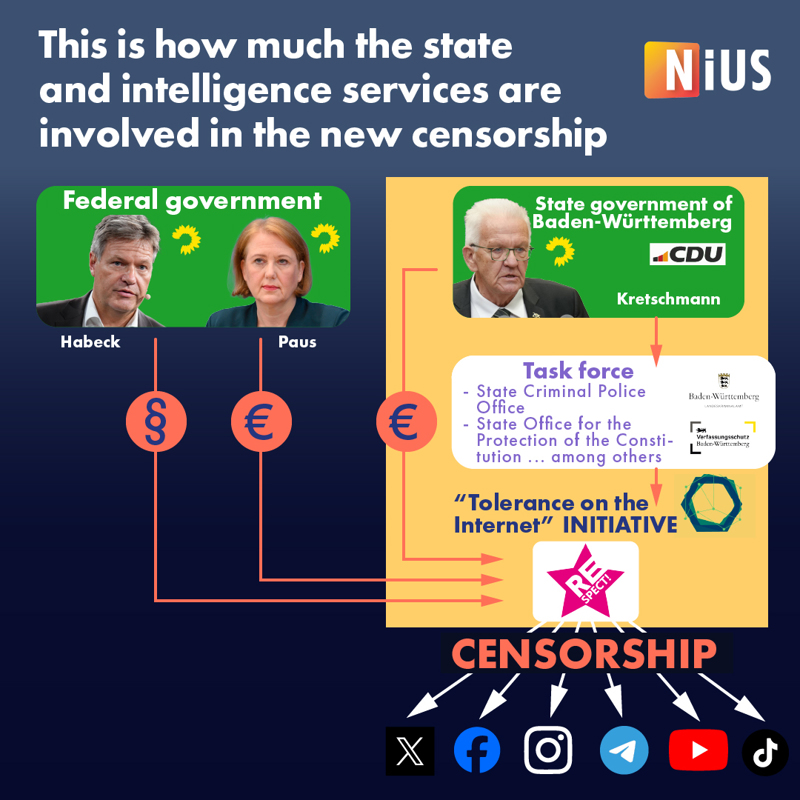
At least as influential and dangerous as HateAid is the first Trusted Flagger authorized by the federal government: the reporting office “REspect.” It too receives generous funding from federal and state governments — over a million euros in taxpayer money. This is especially troubling because the reporting office is also a partner of the Federal Criminal Police Office (BKA) — forwarding not only unwanted comments to platforms but directly to law enforcement. “REspect!” thus operates as an outsourced investigative authority with quasi-state powers but without the strict regulations governing public agencies. Its logo long resembled the red star of the communists.
The appointment of “REspect” as a Trusted Flagger in October 2024 sparked controversy — for several reasons. First, Federal Network Agency chief Müller said in a press release: “Illegal content, hate, and fake news can be removed very quickly and without bureaucratic hurdles.” Once again, criminal liability is blurred by the state, and an unbureaucratic — meaning extrajudicial — removal of content is threatened.
Furthermore, NIUS investigations revealed that the head of “REspect,” Ahmed Gaafar, is a Muslim scholar from Egypt who studied at Al-Azhar University — considered a breeding ground of Islamism — and posed with a Hamas supporter. Shortly after the Trusted Flagger appointment, a 2021 video surfaced in which Gaafar admitted the office also pushes for the deletion of posts that are not criminal: “If it’s not criminally relevant, then we’ll certainly file a deletion request with the provider,” Gaafar told ARD at the time.
Documents obtained by NIUS through a Freedom of Information request — the same documents used by “REspect” to apply for Trusted Flagger certification — show the office is primarily a politician-protection organization. Perhaps that is precisely why it was chosen by the government. Numbers submitted to the Federal Network Agency show that in 2023, politicians accounted for 4,314 reports — the single largest group on whose behalf unwanted comments were flagged.
This is ultimately the central question in the battle over free speech: Who has the final say? The government or the people? Who is sovereign? The constitutions of Western states guarantee citizens the right to criticize — especially the powerful. But in much of Europe, the reality now looks very different.
Mehr NIUS:
Alle Linken ganz verzweifelt: NIUS-Kampagne überrollt die BVG
Vorwurf Steuerhinterziehung: Staatsanwaltschaft ermittelt gegen Grünen-Chef Felix Banaszak
Warum Friedrich Merz in den eigenen Reihen als „Quassel-Kanzler“ gefürchtet ist
Neues 13-Milliarden-Loch für Klingbeil! Bund muss Arbeitsagentur noch viel mehr Steuergeld zuschießen
Gewerkschaften kündigen Widerstand an: Fliegt Kanzler Friedrich Merz sein Reform-Gipfel um die Ohren?
Correctiv lässt sich von der EU bezahlen, um über die EU zu berichten
IPCC-Skandal – der Mann, der dem Klima-Papst widersprach: „Ich glaube, dass die jüngste Erwärmung wohl auch schon vor 1000 Jahren erreicht wurde“
Die hartnäckigste Klima-Lüge: 97 Prozent der Wissenschaftler gehen von menschengemachtem Klimawandel aus
Mehr NIUS:
Neues 13-Milliarden-Loch für Klingbeil! Bund muss Arbeitsagentur noch viel mehr Steuergeld zuschießen
Gewerkschaften kündigen Widerstand an: Fliegt Kanzler Friedrich Merz sein Reform-Gipfel um die Ohren?
Correctiv lässt sich von der EU bezahlen, um über die EU zu berichten
IPCC-Skandal – der Mann, der dem Klima-Papst widersprach: „Ich glaube, dass die jüngste Erwärmung wohl auch schon vor 1000 Jahren erreicht wurde“
Die hartnäckigste Klima-Lüge: 97 Prozent der Wissenschaftler gehen von menschengemachtem Klimawandel aus
Verdi-Chef Frank Werneke: „Der Kanzler hat inhaltlich und im Stil komplett am Saal vorbeigeredet“
„Lügenfritz“ ist strafbar: Bürger muss wegen Merz-Beleidigung zahlen
Tabaksteuer: Lassen sich Kanzler Merz und Finanzminister Klingbeil von Brüssel über den Tisch ziehen?
Pauline Voss
Artikel teilen
Kommentare